Bleeding Taper Candles
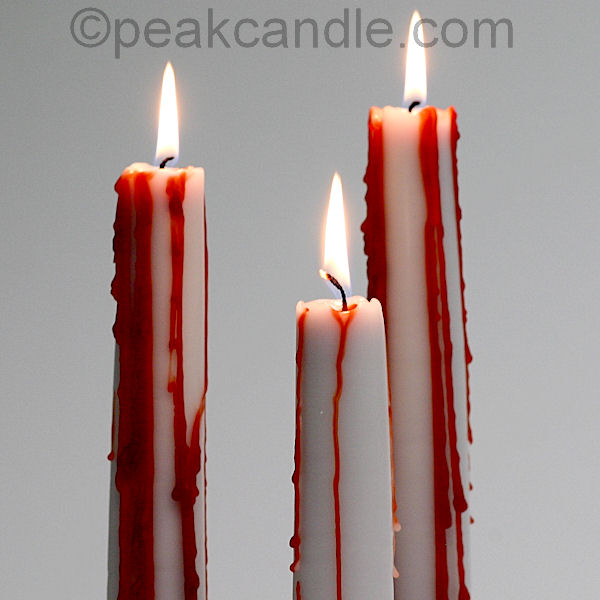
Create an innocent-looking taper candle that "bleeds" when lit!
|
You Will Need:
There are two ways you can create these candles. One is to hand-dip the entire candle, and the other is to use a taper mold for the core and do a white over-dip. Preparing the Core: -Molded: Heat your wax in a double boiler or wax melter to the specified pouring temperature for your wax and add your dye and fragrance. You may need to add more dye than usual to achieve the dark "blood red" color. Wick your taper mold as usual, leaving enough on the top of the candle (the bottom of the mold) to be able to hold onto while you do the over-dip. Pour the red wax into the mold, and fill higher or lower for a taller or shorter candle. Allow to cool completely and remove it from the mold. -Hand-Dipped: Prepare your red wax in a double boiler or wax melter as you would for a molded candle. Now you can either transfer your wax into a dipping vat inside of a stock pot full of simmering water, or just keep it in your double boiler for a shorter candle. Follow the instructions for hand-dipped tapers and allow the core to cool once it has reached the desired size. |
![]() |
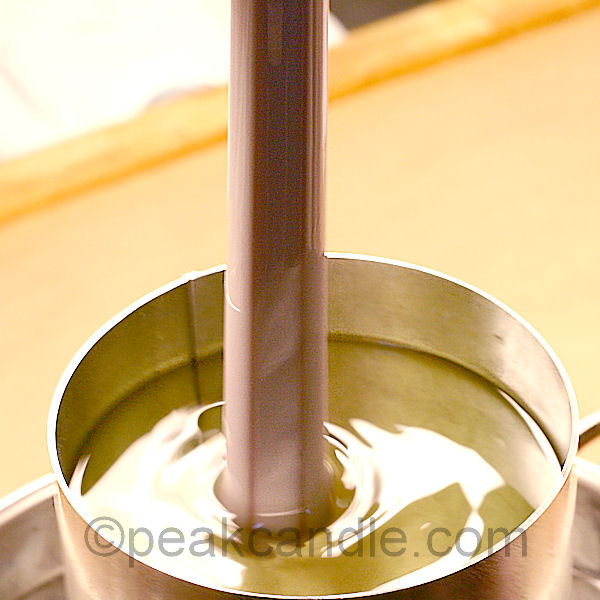
| Preparing the Over-dip Wax: Melt your pillar wax and stearic acid together in a double boiler or wax melter at a ratio of about 40% stearic acid to 60% wax. This will increase the whiteness and opacity of the wax so that it will completely cover the red core. Transfer the wax into a dipping vat inside of a large simmering pot of water. The Over-dip: The ideal temperature for the wax is 165 degrees F. It is important to try to maintain this temperature. The hot water in the pot should aid in keeping the wax hot for a good period of time. Holding on to the wick at the top of the core, dip it into the dipping vat in a swift and even motion. Be sure to completely submerge the candle while avoiding hitting the bottom. Repeat this step until no more of the red is visible. Wait for the candle to cool slightly between dips to avoid any sheeting. When finished, hang the candle upright to cool. Once cool, trim your wick to 1/4 inch. Now you can place your finished candle into a candleholder and light. As the candle burns, the red wax from the core will drip down the sides of the white candle, making it look like it's bleeding! |
![]() |


My question is not related to the tapered candle, but it relates to jar candles. Please tell me what causes wet spots in the jar candles. I work so hard to avoid them and for the life of me - I can't figure out what causes them. On my 1st and 2nd pour the candles are beautiful - no wet spots then after the 2nd pour I put them in a small box, cover the box with a towel or blanket, and let them cool slowly and completely. The next day I uncover them and the ugly wet spots have appeared. I wash the jars before I use them, I warm the jar before the 1st pour; I think I am doing everything correctly but the wet spots appear on some candles yet not on all of them, I pour six at a time and some of the remaining six are perfect, some have wet spots. I am so frustrated, can you help me -- please?
The wet spots you speak of....well....they're normal. They really are. I've been in the candle biz for a darn long time and I've found that the ones that don't display this feature are mass produced, crap candles. (meaning they have nothing of value to offer)
Capitalize on this feature and if it really is a sticking point with you, make these candles rustic, grubby and primitive. It's very popular lately. I ought to know, I inadvertantly started the trend. Imagine my surprise! :)
It's like these "bleeding candles" that Peak Candle now has info on. 2 months ago I inquired about how to make these and now they have it.
My point is this: Capitalize where you can. Use your imagination and make your imperfections, your run for the gold. :)
This is great. I made it for my girlfriend and she loved it. It was so easy to make that even I could make it. That means a lot; if I could make it, anyone could make it. I am making more candles for my family for Christmas. Thanks for such an easy recipe and now the house has these candles everywhere!
Im curious if this can be done with a blue core and orange overdip. With so much vybar in the wax, would it work? Im extremely new to candlemaking, but I have a sister who would kill for these in her school colors!
Hi Kathryn,
You can do it in any combination of colors you like. We just happened to use the colors we chose because it fit in with a Halloween theme, which coincided with the time period that we published this article.
We didn't use any vybar for this project.
Cheers!
Alan, Im going to be starting up with these relatively soon, and I had a question about the overdip... in your article it stated to use 40% vybar to 60% wax, to help the wax be more white... if doing , say a dark blue overdip, orange core, what then? Sorry if this is rather obvious, Im new to all this and trying to learn how to keep from costly mistakes. Thanks in advance!
Looks easy for some new starters… but still wonderful result…! Green-yellow, pink-purple or red-blue colors combinations seem great contrast for this types.
The question on wet spots was a big help to me since I was getting the same results. Thanks
i need help on my science fair project
These are very unique. Always looking for different types of candles.
This is a very nice technique. Thanks for describing it so clearly. I really enjoy things that create a dramatic effect yet are simple to do.
I also liked the idea of doing this in school colors that one of the other comments mentioned. Not only is that fun, but couldn't it be a great fun raising project for a school club or team?
Wow - now that is so cool looking. Great potential for lots of different colors too.!
That is so cool - thanks for the instructions. This would be nice with other colors too.
ur candles are really superb,i would like to know why is steric acid used
These candles air some form of mystery in them. The bleeding design is art in its very essence since no two candles with exactly the same design are formed.